

One of the most common questions artists run into when starting to sell prints is: what sizes should I offer? The answer affects everything — which frames your buyers can use, how you price your work, and how you mockup your listings.
This guide gives you every standard print size in one place, with the aspect ratio for each, so you can design your artwork to exactly the right proportions the first time.
Aspect ratio determines frame compatibility. An 8×10" print and a 16×20" print share the same 4:5 ratio — so the same artwork can be printed at either size without cropping, and each fits a standard 4:5 frame. Knowing your ratio means you can offer multiple sizes from one piece of artwork without redesigning.
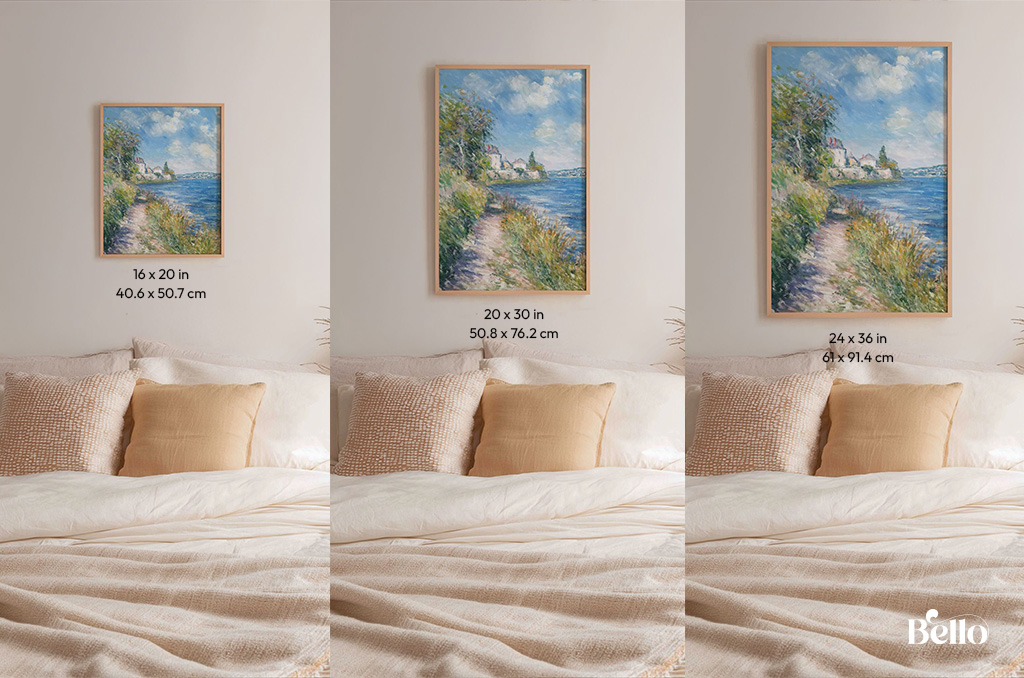
Standard art print sizes (inches)
These are the sizes stocked by most frame retailers and print labs. Choosing from this list means your customers can find ready-made frames locally without any custom cutting.
| Size (in) | Size (cm) | Ratio | Notes |
|---|---|---|---|
| 4 × 6 in | 10 × 15 cm | 2:3 | Photo standard. Fits most photo frames. |
| 5 × 7 in | 13 × 18 cm | 5:7 | Common portrait and greeting card size. |
| 8 × 8 in | 20 × 20 cm | 1:1 | Square. Great for abstract, botanical, and Instagram-native art. |
| 8 × 10 in | 20 × 25 cm | 4:5 | Most popular art print size. Wide frame selection. |
| 8.5 × 11 in | 22 × 28 cm | ~3:4 | Standard US paper (close to 3:4). Good for digital downloads. |
| 9 × 12 in | 23 × 30 cm | 3:4 | Classic vertical canvas proportion. |
| 10 × 10 in | 25 × 25 cm | 1:1 | Square. Popular for gallery groupings and grids. |
| 11 × 14 in | 28 × 36 cm | 11:14 | Very popular gallery and gift size. Its own ratio — not a scaled 8×10. |
| 12 × 12 in | 30 × 30 cm | 1:1 | Square. A bold, modern statement format. |
| 12 × 16 in | 30 × 40 cm | 3:4 | Clean, versatile size. Common in Europe. |
| 16 × 20 in | 41 × 51 cm | 4:5 | Statement piece. Great for gallery walls. |
| 18 × 24 in | 46 × 61 cm | 3:4 | Large-format poster. Strong wall presence. |
| 20 × 24 in | 51 × 61 cm | 5:6 | Popular gallery size. Fits standard mouldings. |
| 20 × 30 in | 51 × 76 cm | 2:3 | Long poster format. Suits landscape or portrait. |
| 24 × 36 in | 61 × 91 cm | 2:3 | Classic movie poster size. Maximum wall impact. |
Standard canvas sizes
Canvas sizes follow slightly different conventions than flat print sizes. Many canvas prints are sold as gallery-wrapped (the image wraps around the stretcher bar) — so your artwork needs to account for the wrap depth on each edge.
| Size (in) | Size (cm) | Ratio | Notes |
|---|---|---|---|
| 8 × 8 in | 20 × 20 cm | 1:1 | Square. Suits abstract and botanical. |
| 8 × 10 in | 20 × 25 cm | 4:5 | Portrait standard. |
| 10 × 10 in | 25 × 25 cm | 1:1 | Small square. Good for groupings. |
| 12 × 12 in | 30 × 30 cm | 1:1 | Medium square canvas. |
| 12 × 16 in | 30 × 40 cm | 3:4 | Classic vertical proportion. |
| 16 × 20 in | 41 × 51 cm | 4:5 | Popular standard canvas. |
| 18 × 24 in | 46 × 61 cm | 3:4 | Large statement canvas. |
| 24 × 36 in | 61 × 91 cm | 2:3 | Oversized. Best with gallery wrap. |
ISO 216 / DIN A-series sizes
The A-series (defined by ISO 216 and DIN 476) is the international standard paper size system used throughout Europe, Australia, and most of the world outside North America. Every size in the series shares the same 1:√2 aspect ratio (approximately 1:1.414), which gives the A-series a unique mathematical property: fold any A-series sheet in half and you get the next size down at the same ratio.
Selling to European buyers? A4 and A3 are the EU equivalents of US Letter and US Tabloid. Buyers in Germany, France, the Netherlands, and the UK will expect to print your digital files at A-series sizes. If you don't offer A-series variants, your EU buyers will often print US sizes that don't fit their local frame selection.
Frame availability: A4 and A3 frames are universally available across Europe. A2 frames are common in furniture and homeware stores. A1 and A0 typically require specialist framers or clip frames.
| Size | mm | inches (approx) | 300 DPI pixels | Notes |
|---|---|---|---|---|
| A6 | 105 × 148 mm | 4.1 × 5.8 in | 1240 × 1748 | Postcard size. Popular for art cards and mini prints. |
| A5 | 148 × 210 mm | 5.8 × 8.3 in | 1748 × 2480 | Half of A4. Common for zines, small prints, and greeting cards. |
| A4 | 210 × 297 mm | 8.3 × 11.7 in | 2480 × 3508 | Standard European office paper. The EU equivalent of US Letter. |
| A3 | 297 × 420 mm | 11.7 × 16.5 in | 3508 × 4961 | Popular mid-size print in EU. Slightly larger than 11×14 in. |
| A2 | 420 × 594 mm | 16.5 × 23.4 in | 4961 × 7016 | Large statement print. Common in European galleries. |
| A1 | 594 × 841 mm | 23.4 × 33.1 in | 7016 × 9933 | Exhibition and large-format poster size. |
| A0 | 841 × 1189 mm | 33.1 × 46.8 in | 9933 × 14043 | Largest standard size. Specialist print labs only. |
A-series vs. US sizes: the closest equivalents
| ISO size | Closest US size | Difference |
|---|---|---|
| A6 (105×148mm) | 4×6 in (102×152mm) | A6 slightly wider, slightly shorter |
| A5 (148×210mm) | 5.5×8.5 in (140×216mm) | A5 slightly wider, slightly shorter |
| A4 (210×297mm) | Letter 8.5×11 in (216×279mm) | A4 narrower and taller — not interchangeable |
| A3 (297×420mm) | 11×17 in Tabloid (279×432mm) | A3 wider and slightly shorter |
| A2 (420×594mm) | 16×24 in (406×610mm) | A2 slightly wider but slightly shorter |
| A1 (594×841mm) | 24×36 in — closest large format | A1 slightly narrower and shorter |
Important: A4 and US Letter are not the same size and are not interchangeable in frames. If you're offering digital downloads for both markets, provide separate files or clearly state the dimensions so buyers can crop to their preferred format.
Understanding aspect ratios
The aspect ratio is the relationship between the width and height of your artwork. Knowing your ratio is more useful than knowing your size — it tells you which frames are compatible and lets you scale your artwork up or down without cropping.
1:1 (Square) · fits: 8×8, 10×10, 12×12
Works well for abstract art, botanicals, and photography. Easy to group in grids.
2:3 · fits: 4×6, 20×30, 24×36
The standard photo ratio. Very widely supported by frame manufacturers.
3:4 · fits: 9×12, 12×16, 18×24
A natural portrait proportion. Note: while 3:4 looks similar to ISO A-series, the A-series ratio is actually 1:√2 (≈ 1:1.414) — slightly different. A3 and A4 prints will not fit 3:4 frames without a small gap or trim.
A-series (1:√2) · fits: A6, A5, A4, A3, A2, A1, A0
The ISO 216 standard ratio used globally outside North America. All A-series sizes share this ratio — fold in half to get the next size. Dedicated A-series frames are widely available across Europe.
4:5 · fits: 8×10, 16×20
The most popular art print ratio. Also how Etsy displays listing thumbnails in search results.
5:7 · fits: 5×7, 10×14
Common portrait and gift frame size. Narrower than 3:4.
Which sizes should you sell?
Start with 8×10 and 11×14
These are two of the most widely purchased art print sizes, and every frame retailer carries them. 8×10 is the classic 4:5 ratio — which also matches how Etsy displays listing thumbnails in search results. 11×14 has its own 11:14 ratio, so treat it as a separate size rather than a scaled-up 8×10.
Add 18×24 for a statement piece
Offering a large-format option can significantly increase your average order value. 18×24 is a sweet spot — large enough to feel like a statement piece, but not so large that buyers hesitate on cost.
Offer sizes in the same ratio family when possible
If your artwork is designed at 3:4 (e.g., 12×16), you can also offer it at 9×12 and 18×24 without any cropping. Your buyers get size options; you have no extra design work.
Be careful with unusual ratios
Sizes like 7×11 or 13×19 look appealing but may not fit any frames your buyers can find locally. Stick to common frame ratios unless you're offering framing options yourself.
Resolution requirements by size
Print resolution is measured in DPI (dots per inch). For fine art prints, 300 DPI is the professional standard. Here's the minimum pixel dimensions for 300 DPI prints at each common size:
| Print Size | 300 DPI pixels | 150 DPI pixels | Notes |
|---|---|---|---|
| 8 × 10 in | 2400 × 3000 | 1200 × 1500 | Acceptable at 150 DPI for offset litho |
| 11 × 14 in | 3300 × 4200 | 1650 × 2100 | 300 DPI recommended for fine art |
| 16 × 20 in | 4800 × 6000 | 2400 × 3000 | Typical Lightroom/Photoshop export target |
| 18 × 24 in | 5400 × 7200 | 2700 × 3600 | 200 DPI minimum for this size at normal viewing distance |
| 24 × 36 in | 7200 × 10800 | 3600 × 5400 | Large format: 150 DPI acceptable, 200+ preferred |
See your art in every size
Preview your prints to scale — free
Upload your artwork to Bello Studio and see exactly how it looks at 8×10, 16×20, and any size in between. True-to-scale rendering — no guessing.
TRY STUDIO FREE